Sprint Triathlon Coaching: Intensity Over Volume

Intro
Sprint triathlon is often perceived as the “simpler” or more accessible end of the sport. In reality, sprint triathlon places athletes under some of the highest relative intensity demands in the sport.
For coaches, this changes the problem entirely. Sprint triathlon performance is less about accumulating large training volumes and more about preparing athletes to repeatedly operate close to their physiological and technical limits. Coaching sprint well requires a deliberate shift in priorities, from building endurance through volume to developing the capacity to execute at high intensity with precision and control.
This article explores why sprint triathlon is an intensity-driven discipline and how that reality should shape coaching decisions.
Key Takeaways for Coaches
- Sprint triathlon is a high-intensity performance problem, not a volume problem
- Prioritizing intensity does not mean eliminating aerobic work, but protecting quality
- Training decisions should support repeatable high-intensity execution
- Excessive volume often compromises sprint-specific performance
- Technical execution and transitions matter more as race duration shortens
- Sprint-focused training must still be intentionally placed within the season
Why Sprint Triathlon Is a High-Intensity Problem
Sprint triathlon compresses performance demands into a short window, leaving little margin for error. Athletes are required to produce a high percentage of their maximum sustainable output across all three disciplines, with minimal opportunity to recover or “ride out” mistakes.
Unlike longer formats, sprint races:
- Begin at high intensity almost immediately
- Include frequent surges, accelerations, and tactical changes
- Demand rapid transitions between effort levels
The result is a race profile that stresses not only aerobic capacity, but also neuromuscular readiness, pacing discipline, and technical execution under fatigue.
Because race duration is short, athletes cannot rely on gradual pacing adjustments or conservative early strategies. From the opening swim strokes to the final meters of the run, performance is defined by how effectively intensity can be sustained without degradation in form or decision-making.
For coaches, this means sprint triathlon should be treated less as a shortened endurance event and more as a high-intensity performance challenge that exposes weaknesses quickly. Training approaches that prioritize volume accumulation without protecting intensity quality often fail to prepare athletes for the specific demands they will face on race day.

Support High-Intensity Sprint Coaching Decisions
What “Intensity Over Volume” Really Means in Sprint Coaching
The phrase “intensity over volume” is often misunderstood in endurance training, and sprint triathlon is no exception. For coaches, prioritizing intensity does not mean abandoning aerobic development or training hard at every opportunity. Instead, it reflects a shift in emphasis toward the qualities that most directly influence sprint race performance.
In sprint triathlon, athletes are required to sustain a high percentage of their maximal capacity across all three disciplines, with little opportunity to compensate through pacing or duration. As a result, training must prepare athletes to tolerate and repeat high-intensity efforts while maintaining technical and tactical control.
What intensity over volume does not mean
To apply this principle correctly, it’s important to first clarify what it does not represent:
- It does not mean eliminating aerobic training or base work
- It does not mean maximizing intensity at the expense of recovery
- It does not mean treating sprint training as random or unstructured
Volume still plays a role in sprint preparation, but it serves to support intensity, not replace it. Aerobic capacity provides the foundation that allows athletes to recover between high-quality efforts and maintain consistency over the season.
What intensity over volume does mean for coaches
From a coaching perspective, emphasizing intensity over volume involves making deliberate trade-offs in how training time and stress are allocated.
In practice, this often means:
- Protecting key high-intensity sessions by limiting unnecessary volume
- Structuring training weeks so intensity can be repeated without degradation
- Accepting lower total training hours if they allow higher-quality execution
- Monitoring fatigue closely, as high-intensity work carries a significant recovery cost
These decisions require restraint. Adding volume is often the easiest way to increase training load, but in sprint triathlon it can quickly undermine the very qualities coaches are trying to develop.
Coaching Sprint Triathlon: Applying Intensity Over Volume
Applying an intensity-first approach in sprint triathlon is less about prescribing specific workouts and more about shaping training decisions over time. For coaches, this means constantly evaluating whether the training structure supports high-quality execution or simply accumulates fatigue.
Sprint-focused training rewards precision. Small compromises in session quality or recovery can have a disproportionate impact on race-day performance.
Protecting key intensity sessions
High-intensity sessions are central to sprint preparation, but they are also the most fragile. Their effectiveness depends on the athlete’s ability to execute them with appropriate power, speed, and technical control.
From a coaching perspective, this often requires:
- Limiting preceding volume that compromises session quality
- Avoiding unnecessary intensity stacking across disciplines
- Ensuring athletes arrive at key sessions sufficiently recovered
Protecting these sessions may mean reducing total training hours, but the trade-off is higher-quality work that better reflects sprint race demands.
Structuring the week to support repeatable intensity
Sprint triathlon training should allow athletes to repeat high-intensity efforts across the week, not simply survive a single hard session. This places a premium on week-level structure, not just individual workouts.
Effective sprint-focused weeks often:
- Distribute intensity to avoid excessive clustering
- Include deliberate lower-stress days to facilitate recovery
- Prioritize consistency of execution over maximal stress
For coaches, the goal is to create a rhythm where intensity is sustainable, rather than sporadic or reactive.
Managing recovery despite short race distances
One of the most common sprint coaching mistakes is underestimating recovery needs. While sprint races are short in duration, the relative intensity is high, and the neuromuscular and metabolic cost can be significant.
Coaches should pay close attention to:
- Signs of declining session quality
- Changes in coordination or technical execution
- Increased perceived effort at familiar intensities
Aggressive recovery management is often required to preserve intensity tolerance over the season.
Accepting trade-offs in training decisions
An intensity-first approach forces coaches to make trade-offs. Increasing volume may improve aerobic capacity, but it can also blunt intensity expression. Conversely, prioritizing intensity may limit total training hours but improve race-specific readiness.
Effective sprint coaching involves choosing the trade-offs that best support race performance, rather than attempting to maximize all qualities simultaneously.
Key takeaway for coaches
Applying intensity over volume in sprint triathlon is about protecting quality. Coaches who prioritize execution, manage fatigue proactively, and structure training for repeatable intensity are better positioned to prepare athletes for the demands of sprint racing.
A 4-Week Sprint Triathlon Block Focused on Intensity
This four-week example illustrates how sprint triathlon training can be structured to prioritize high-quality intensity while managing fatigue. It is not a universal template, but a conceptual example of how coaches might sequence training blocks to develop neuromuscular readiness, intensity tolerance, and race-specific execution leading into a sprint event.
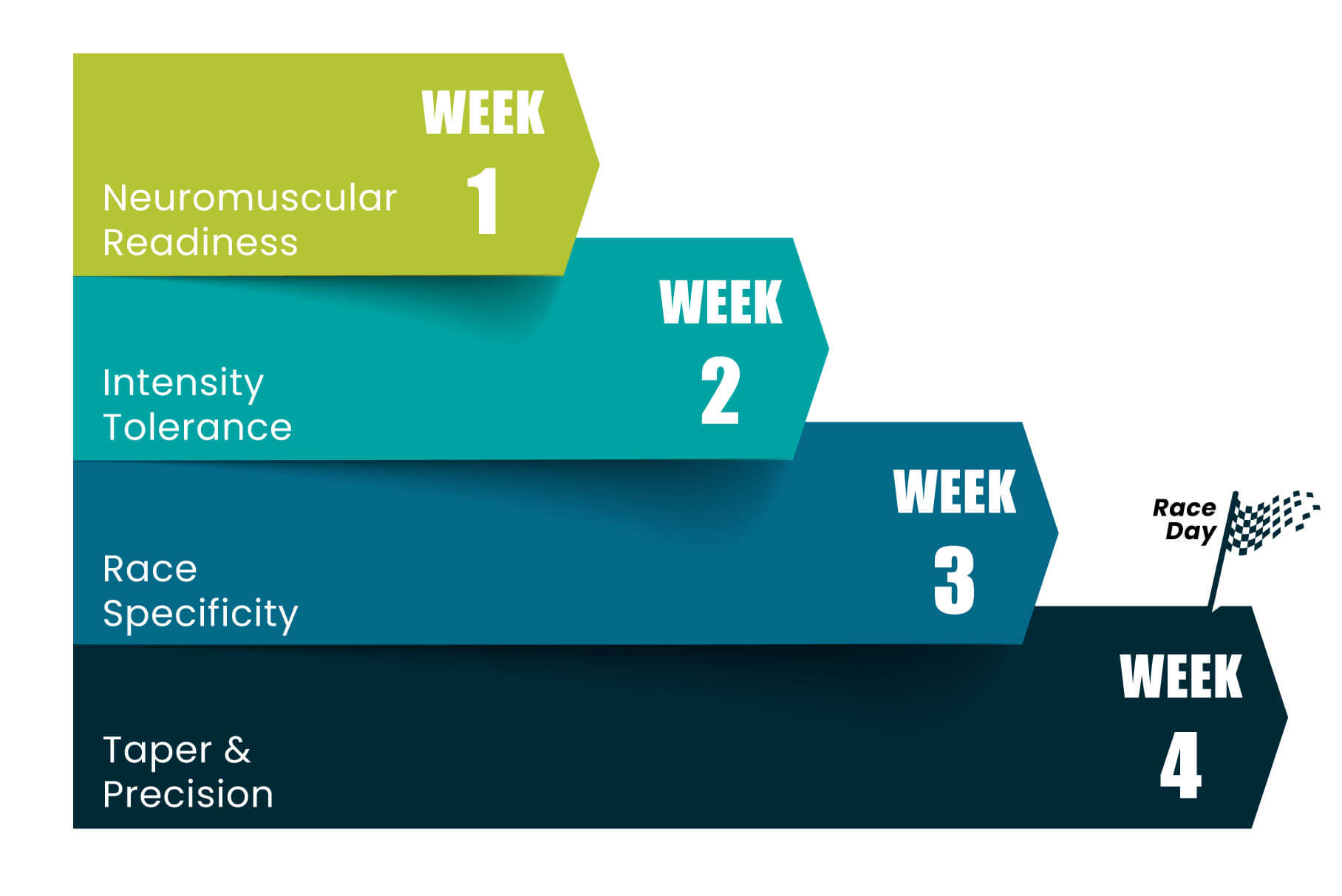
Week 1: Neuromuscular Readiness
Goal: Establishing the rhythm of high intensity without clustering fatigue.
| Monday | Tuesday | Wednesday | Thursday | Friday | Saturday | Sunday |
|---|---|---|---|---|---|---|
| REST Full recovery | SWIM Speed Intervals | BIKE Cadence Surges | RUN Hill Repeats | SWIM Technical Recovery | BRICK Race Simulation | BIKE Aerobic Base |
| 15 × 50 m @ faster than race pace | 45 min with 5 × 2 min @ 100+ RPM | 30 min with 6 × 30 sec max power efforts | 30 min easy, focus on sighting and control | 10 min swim / 20 min bike / 10 min run | 60 min steady (Zone 2) |
Week 2: Building Intensity Tolerance
Goal: Extending the duration of intensity while monitoring execution quality.
| Monday | Tuesday | Wednesday | Thursday | Friday | Saturday | Sunday |
|---|---|---|---|---|---|---|
| REST Full recovery | SWIM Threshold Ladders | BIKE Threshold Intervals | RUN Tempo Run | SWIM Technical Recovery | BRICK Compound Session | RUN Aerobic Base |
| 4 × (100 hard / 50 easy / 100 hard) | 3 × 8 min @ race pace | 15 min warm-up, 15 min @ 5 km pace | Focus on body position and efficiency | 30 min bike with surges + 2 km fast run | 45 min steady (Zone 2) |
Week 3: Peak Specificity (The “Test” Week)
Goal: Operating near physiological limits and testing execution under fatigue.
| Monday | Tuesday | Wednesday | Thursday | Friday | Saturday | Sunday |
|---|---|---|---|---|---|---|
| REST Aggressive recovery | SWIM Time Trial Effort | BIKE VO₂ Max | RUN Track Speed | Active Recovery | BRICK Transition Blitz | BIKE Aerobic Base |
| 400 m race effort (2 × 200 m) | 5 × 3 min @ 110% FTP (above race pace) | 8 × 400 m @ faster than race pace | Mobility / Stretching | 3 rounds:5 min hard bike → T2 → 1 km fast run | 75 min steady ride |
Week 4: Taper & Precision
Goal: Reducing fatigue while keeping neuromuscular systems sharp.
| Monday | Tuesday | Wednesday | Thursday | Friday | Saturday | Sunday |
|---|---|---|---|---|---|---|
| REST Full recovery | SWIM Full recovery | BIKE Openers | RUN Shakeout | REST | ActivationSession | RACE DAY |
| 10 × 50 m fast with long rest | 30 min with 3 × 45 sec spin-ups | 20 min easy with 4 short strides | Gear check and preparation | 10 min swim / 10 min bike / 5 min run fast run | Sprint Triathlon |